- Home
- Seeds
- Fodder grasses and legumes
- SMALL GRAIN LEGUMES
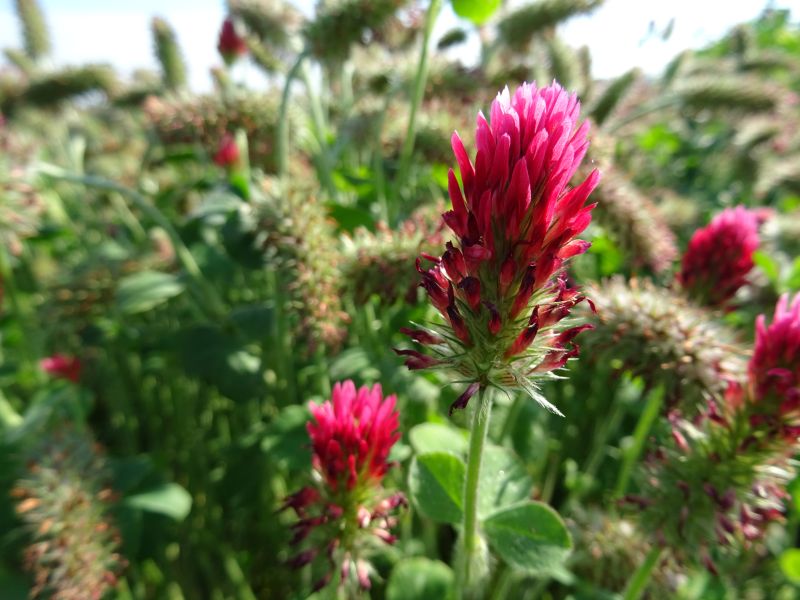
- Crimson clover TARDIVO
FOR CONSULTATIONS APPLY TO:
Commercial director
Lina Smalskienė
tel. +370 618 02 551
e-mail linak@agrolitpa.lt
Sales manager
Tautvydas Kliučininkas
tel. +370 681 35 093
e-mail tautvydask@agrolitpa.lt
Sales manager
Eglė Petkevičienė
tel. +370 626 95 458
e-mail eglep@agrolitpa.lt
Sales manager
Kotryna Nakrošytė
tel.: +370 601 39 282
e-mail kotryna@agrolitpa.lt
Products
Late variety of crimson clover for protein-rich forage, cover crops or beauty
- Late flowering
- Increased the flexibility of exploitation
- Maintains its food value for longer
- For early exploitation in spring
- Non-meteorizing
- Approved in organic farming
- Very good productivity
- Excellent fodder or cover crop, green manure
- Upright, 60-80 cm tall plants
- Tap roots
- Flowers about 20 days later compared to traditional varieties
- Due to later flowering, longer suitable for fodder, higher green mass yields
- Good resistance to frost and diseases
- Seed yield can reach 600-800 kg/ha
- Like all other legumes, improves soil fertility
- Thanks to a good, very dense and quite deep root system, improves soil structure
- Fixes atmospheric nitrogen
- Grows quickly and covers the soil well
- Effective for weed control
- Optimal soil pH – 6.2-7
- Likes water-permeable soils
- Likes loamy, calcareous soils
- Should not be grown on light, sandy, dry soil
- Very good nutritional value of feed, high in protein
- Does not cause meteorism in animals
- Can be used for hay, silage
- When grown pure, 20-30 tons/ha of easily digestible fresh fodder can be obtained
- Crimson clover should be cut for fodder at the latest at the beginning of flowering
- Can be grown with Italian ryegrass, Egyptian clover, vetches, oats, but does not like competition from other plants
- When grown together with vetches and ryegrass, the quality and quantity of the mixture improves
- Suitable for organic farms
The varietal parameters may differ from those indicated here when the testing circumstances differ from quondam
Recommended sowing rate when growing for fodder or green manure: 25-30 kg/ha (6 million viable seeds/ha), interrows 12 cm.
Recommended sowing rate when growing for seed production: 16-18 kg/ha (4 million viable seeds/ha), interrows 20 cm. Sowing depth - 1-2 cm.








Keravos sreet. 17, Kerava,
LT-38 131 Panevėžys district, LITHUANIA
Enterprise's code 168598128
VAT code LT685981219
Tel. +370 615 11 315
E. mail info@agrolitpa.lt