SITO 70
Secale cereale L.
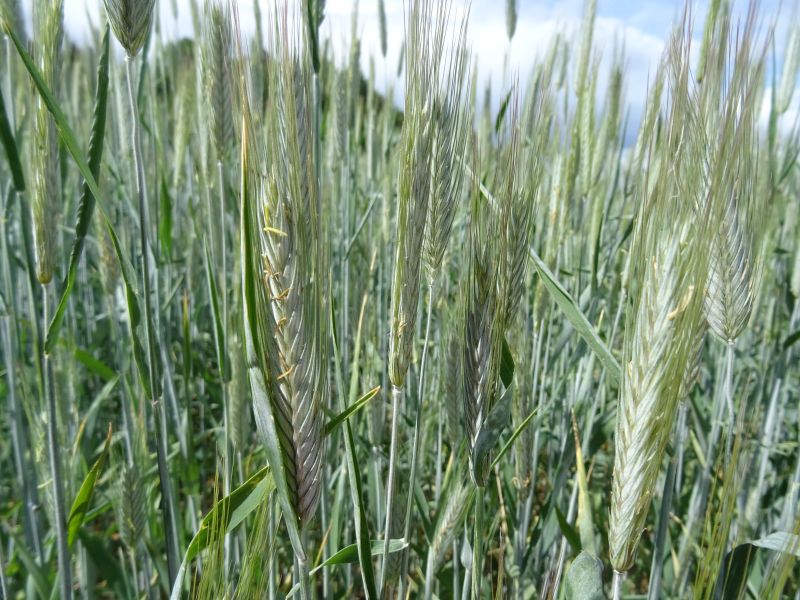
Very early, high-yielding, alternative rye variety for green fodder or green fertilizer
- High yield
- Grain yield – 3.0-3.5 t/ha
- Green mass yield (at heading stage) – 10.0-15.0 t/ha, on more fertile soils – 20.0-22.0 t/ha
- Highly tillering
- Foliage – leaves are long and wide
- Plant height during flowering – 2 m (very tall)
- Sensitive to lodging, avoid excess of nitrogen
- Winter-hardy
- Good resistance to major rye diseases
- 1000-grain weight – 27-28 g
- Grains – large, dark green
- Grains can be used for feed or harvested matured for flour production
- Used for grazing, hay, silage, straw, green manure
- Used as early fodder
- It has a lot of sugar at heading stage
- It is best to consume it for feed before heading, later it starts to harden and is less digestible
- It has a lot of sugar in the green mass, so it is suitable for silage when chopped without drying and preservatives
- Suitable for hay production
- Phosphorus and nitrogen fertilizers will increase the yield
- Can be sown alone or with legumes
- If the fodder is harvested early, other crops can be sown after them
- Rye is less demanding on growing conditions than wheat (especially for soil)
- Tolerates more acidic, low-fertile, light soils
- Grows well at pH 5.3-6.5
- Grows poorly in heavy clay, marshy and saline soils
- Has a well-developed root system that penetrates to a depth of 1.5-2 meters and is able to absorb phosphorus and potassium from poorly soluble compounds
- Withstands temperature drops at the level of the growth cone to minus 19-21 ° C
- Seeds begin to germinate at a temperature of +0.5-2 ° C
- The growing season ends in autumn and renewed in spring, at a temperature of +3-4 °C
- Perfect for green manure
- Has unique phytosanitary properties: protects against weeds (even perennial ones – Elytrigia repens, Sonchus arvensis, Ranunculus arvensis/repens), because it prevents weed seedlings from growing
- Disinfects the soil after potatoes (reduces nematode infestation)
- Rye grows well in spring, thus for green manure could be used in spring, when the plants are about 60 cm high, incorporated to 3-5 cm depth)
- Young plants decompose quickly and enrich the soil with organic and mineral substances (mainly nitrogen and potassium)
- The applied for green manure mass is about 3-5 kg/m2, which is equivalent to an average dose of manure
- Rye is destroyed 1.5-2 weeks before sowing the main crop (if the weather is dry, then it will take time for the green mass to be destroyed to accessible nutrients)
- The disadvantage of using rye as a “green manure” is its strong drying effect on the soil, so it is better to grow it when there is enough moisture
- It should be sown in autumn so that the plants have time to reach a height of 20-25 cm before the frosting
The varietal parameters may differ from those indicated here when the testing circumstances differ from quondam

Recommended sowing rate: 180-220 kg/ha
Galery





UAB „Agrolitpa“
Keravos sreet. 17, Kerava,
LT-38 131 Panevėžys district, LITHUANIA
Enterprise's code 168598128
VAT code LT685981219
Tel. +370 615 11 315
E. mail info@agrolitpa.lt
Keravos sreet. 17, Kerava,
LT-38 131 Panevėžys district, LITHUANIA
Enterprise's code 168598128
VAT code LT685981219
Tel. +370 615 11 315
E. mail info@agrolitpa.lt